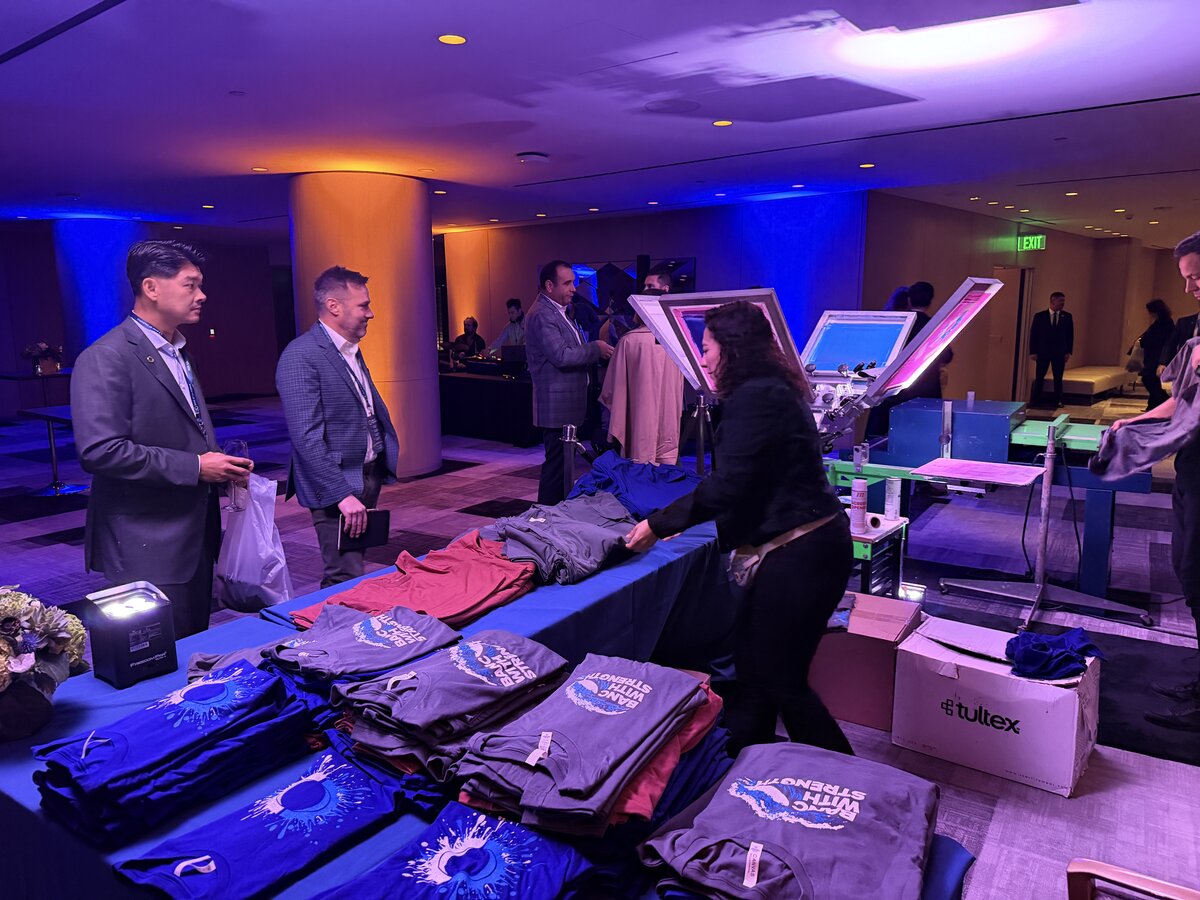
A live heat press activation looks simple from the guest side: pick a design, hand over a blank, and walk away with a freshly pressed shirt a minute later. Behind that minute is a planning process that decides whether your line stays calm or backs up across the floor. This guide walks event producers through everything Merch Troop locks down before a live heat press station goes live, from the layout of the guest path to the heat-and-dwell recipe, the product menu, staffing ratios, turnaround math, and the factors that actually move pricing.
Plan the guest path before the machine
The most common mistake with live heat press is planning around the press instead of the line. A single press can cure a transfer in seconds, but a guest still has to enter, choose a design, choose a size, wait, and pick up. If any of those steps stalls, the whole activation feels slow no matter how fast the plate is. We map the path first: a clearly marked entry, a design menu guests can read in a glance, a sizing station, a short numbered wait, and a separate pickup point so finished pieces never collide with people still choosing.
For a busy floor, separating "choose" from "collect" is the single biggest speed upgrade. It lets one staffer keep the queue moving while another runs the press, and it keeps the visual of finished merch leaving the booth, which is what pulls the next wave of guests in.
What to confirm with the venue
- Power: a heat press draws a real load; confirm a dedicated 110V circuit, or 220V for larger plates, and the distance to the nearest outlet.
- Footprint: a counter, the press, a peel station, and blank storage; most setups fit a 10x10 or even a 6-foot table run.
- Load-in and hours: when the dock opens, how long setup takes, and the exact run window so staffing matches the active hours.
- Ventilation: transfers release a little heat and odor; an open or well-circulated space keeps the booth comfortable.
Heat, dwell, and peel: the recipe basics
Every transfer type has a recipe: a temperature, a dwell time, a pressure, and a peel style. Get the recipe right and the print bonds permanently and survives the wash; get it wrong and you see lifting edges, cracked ink, or scorched fabric. Merch Troop tests the recipe on the exact blank before event day so the operator is never guessing under a line of guests.
The four variables
- Temperature: most DTF and heat-transfer vinyl presses run roughly 300 to 320 F; delicate or performance fabrics run cooler.
- Dwell time: the seconds the plate stays down, commonly 10 to 15 seconds, balanced against fabric tolerance.
- Pressure: firm and even; uneven pressure is the usual cause of half-adhered prints.
- Peel: hot peel vs. cold peel changes the finish and is set by the transfer film, not by preference.
Because the recipe changes with fabric, we keep the menu of blank types tight on event day. A focused menu means one or two proven recipes instead of a dozen, which keeps the line consistent and fast.
Build a product menu that runs clean
Live heat press handles a wide range of items, but the strongest activations curate rather than offer everything. Soft cotton and cotton-blend tees take transfers beautifully and are the workhorse of most events. Hoodies and crewnecks add a premium feel for cooler venues. Jerseys, patches, and patch-front hats give a sports or streetwear edge. Tote bags and event uniforms round out a corporate program.
The trick is picking two or three blanks that share similar press settings, then offering a handful of designs and a personalization option on top. That gives guests real choice while keeping the operator on a tight, repeatable rhythm.
Personalization that scales
The moment that makes a live heat press booth memorable is personalization: a name, a number, a date, or a city pressed on alongside the main artwork. Names and numbers are pre-cut or printed in small batches and added as a second press, so the personal touch never slows the core line. For sports and team events, jersey numbers are the headline feature; for conferences, a first name or role line turns a generic giveaway into something guests actually wear home.
Turnaround, staffing, and throughput
Real throughput depends on the line, not the plate. A well-run single-press station with a clean queue typically produces dozens of finished pieces per hour; adding a second press and a dedicated peel station roughly doubles it. The right staffing ratio is usually one operator on the press, one managing the queue and sizing, and a third on personalization or pickup for high-volume windows.
Staffing a smooth line
- Operator: runs the press to the tested recipe and keeps the rhythm.
- Host: greets guests, captures the design and size, and keeps the queue numbered and calm.
- Finisher: handles personalization, peels, folds, and hands off finished merch.
Merch Troop staffs to the active guest hours, including setup and teardown, so the booth is ready before doors and broken down without eating into your venue window.
What moves the price
Live heat press pricing is built from a handful of inputs: the number of event hours, how many operators the line needs, the guest count and the merch quantity you want produced, the blanks themselves and whether we source them, the artwork and personalization prep, and travel. A station running four hours for a few hundred guests with sourced blanks is a different quote than a two-day conference with personalization on every piece. The most accurate quote comes from sharing the product, guest count, city, venue, and deadline up front so nothing is estimated blind.
Live heat press planning FAQ
How far in advance should I book a live heat press activation?
Two to four weeks is comfortable for a local Southern California event, which gives time to source blanks, prep artwork, and test the press recipe. Larger or out-of-state programs benefit from more lead time, but Merch Troop can move quickly when a date is tight.
How much space does a live heat press booth need?
A single-press station fits comfortably in a 10x10 footprint and can run on a standard 6-foot table with room for blank storage and a pickup point. We confirm power and layout with the venue before load-in.
Can guests personalize their item on site?
Yes. Names, numbers, dates, and short custom lines are added as a quick second press, so personalization is part of the experience without slowing the main line.
Plan your activation
Spec your live heat press station with Merch Troop
Tell us the product, guest count, city, venue, and deadline, and we will recommend the right station, crew, and product plan for your event.